


Financial advising on Nextdoor: 2026 insights for advertisers
61% of UK neighbours are likely to hire or switch to a new financial adviser in the next 12 months — 22% more likely than the general population.
That intent sits on top of a goal-oriented, financially engaged audience: most neighbours are working toward a specific financial goal, most already hold investments, and a meaningful share already work with an adviser. They're stressed about money, still rely on basic banking apps day to day, and increasingly turn to AI tools before anything else when they need investment guidance.
For financial advisers, wealth managers, and investment platforms, that combination — high switching intent, high financial engagement, and a documented preference for local, accessible advice — makes right now the moment to show up. This is exactly the kind of neighbourhood intelligence that Nextdoor advertising was built to reach, and financial advising conversations on the platform are already growing 26% year over year.
Neighbours are planning ahead, but managing money still feels stressful
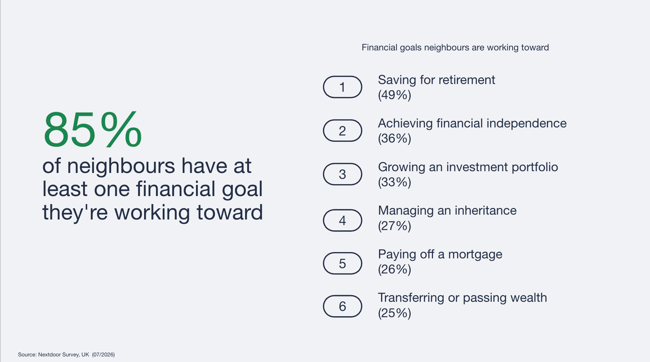
85% of neighbours have at least one financial goal they're actively working toward, and the goals skew long-term rather than short-term.
- Saving for retirement (49%) and achieving financial independence (36%) top the list, followed by growing an investment portfolio (33%)
- Managing an inheritance (27%) and passing on wealth (25%) round things out — a notably strong showing for estate-related goals
That planning mindset comes with real friction: 57% of neighbours find managing their finances stressful or overwhelming, and day-to-day money management still runs through basic bank apps (61%) far more than dedicated tools like Monzo (33%) or a personal spreadsheet (30%) — even though 72% would welcome one app that brings all their accounts together.
Implication for advertisers: Anchor upper-funnel brand campaigns in outcome-driven, milestone-framed messaging — retirement and passive-income solutions as the primary hook, with inheritance and estate products as a strong secondary one given the 27% managing an inheritance. For fintech and aggregators, the 72% open to account consolidation is real whitespace, but competitive positioning needs to reference the players neighbours actually use — Revolut, Monzo, and Starling sit alongside the traditional banks here, unlike in most other markets.
A large, switch-ready audience is approaching a decision
40% of neighbours currently work with a financial adviser — 43% more likely than the general population — and a majority are open to changing that relationship soon.
That adviser-literate base is also restless. 61% are likely to hire or switch to a new adviser in the next 12 months — 22% more likely than the general population — most often because their financial situation has become more complex (48%) or they want to consolidate accounts (40%). A notable share are also unhappy with fees, performance, or service (31%, 29% more likely than the general population), which is a direct conquesting opening rather than just a complexity story.
Implication for advertisers: This is an adviser-literate market, so spend should go toward conversion and conquesting, not educating a cold audience. Use confidence-building, low-barrier offers — a free consultation, a no-obligation portfolio review — to convert neighbours who are open but not yet committed, and lean into fee and service transparency to win the 31% who are actively dissatisfied with their current setup.
Neighbours want local convenience as much as expertise
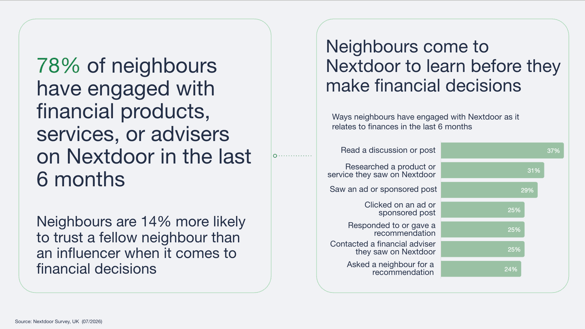
78% of neighbours have engaged with financial products, services, or advisers on Nextdoor in the last six months, and neighbours are 14% more likely to trust a fellow neighbour than an influencer when it comes to financial decisions.
Discovery leans on a mix of search and word of mouth — 21% found their current adviser through online search and 20% through a referral from family or friends, with employer-sponsored benefits (19%) and professional referrals (17%) close behind. But when neighbours weigh a new adviser, convenience and accessibility (55%) rank as the single most important factor — ahead of historical investment performance (53%), relevant expertise (52%), and personal referral (50%).
Implication for advertisers: Convenience and accessibility topping the list speaks directly to what Nextdoor delivers better than a national channel — a brand showing up among neighbours in their own postcode reads as reachable and local in a way a national search ad never can. Messaging should emphasise local availability and ease of getting started ("An adviser near you, whenever you're ready"), paired with a strong always-on search presence and referral-style social proof to capture neighbours at both discovery moments.
Neighbours invest for themselves, and increasingly ask AI for help
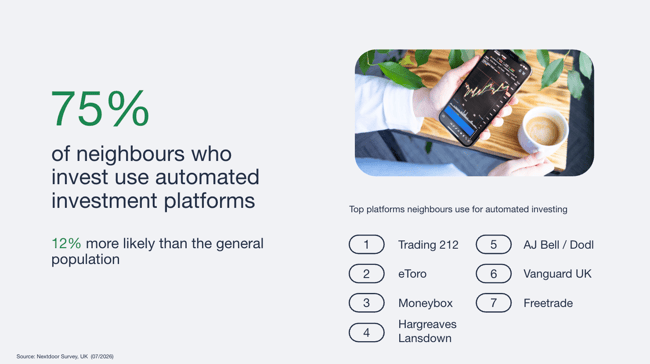
77% of neighbours have investments, and most steer their own decisions — 32% invest independently, 18% consult an adviser, and 16% let an adviser lead.
- 75% of investing neighbours use automated platforms — 12% more likely than the general population — led by Trading 212, eToro, and Moneybox
- 65% adjusted their investment strategy in the last 12 months in response to the economy, most often by increasing savings (39%) or building cash holdings (33%)
The standout finding here is guidance: AI tools are now the single most-used source for investment guidance (36%), ahead of financial news sites (35%), friends and family (32%), and even a professional financial adviser (30%). That's an early-adopter, digitally confident audience that automated and human advisers alike need to compete for.
Implication for advertisers: Brokerages and self-directed platforms should lean into AI-powered tools and features as a genuine differentiator here, not just a nice-to-have. Human advisers should counter-position on what AI and automation can't replace — holistic, life-stage judgement — while making sure their own content is clear and credible enough to hold up against an AI answer. Flight campaigns to market-moving events rather than a static calendar, since this audience visibly reacts to the economy.
Financial advising advertising playbook: how to activate on Nextdoor
Bringing it all together, here’s how to turn these insights into action:
1. Lead with long-term goals, not short-term offers
85% of neighbours are working toward a financial goal, led by retirement (49%) and financial independence (36%). Use outcome-driven, milestone-framed creative, with inheritance and estate messaging as a strong secondary hook given the 27% managing an inheritance.
2. Convert switch-ready intent now
61% of neighbours are likely to hire or switch advisers in the next year, and 31% are actively unhappy with their current adviser's fees or service. Run acquisition and conquesting campaigns with low-barrier offers and transparent-fee messaging rather than educational content this audience doesn't need.
3. Win on local convenience
Convenience and accessibility (55%) beat investment performance, expertise, and referrals as the top factor in an adviser search. Lead with local presence and ease of getting started — this is the exact advantage Nextdoor has over national channels.
4. Show up in the estate-planning conversation
Will-writing and estate-planning promotion already makes up 19% of financial advising conversations on Nextdoor, second only to neighbours actively seeking adviser recommendations (24%). Firms with estate, IHT, or wealth-transfer specialisms should show up authentically in these threads.
5. Compete with the AI answer
AI tools are now neighbours' top source for investment guidance, ahead of financial news, friends and family, and professional advisers. Fintech brands should lean into AI-powered features as a differentiator; human advisers should make the case for judgement and relationship that automation can't replace.
Source: Nextdoor Survey, UK (07/2026); Nextdoor Internal Data, UK (07/2024-07/2026)