


Holiday shopping on Nextdoor: 2026 insights for advertisers
UK neighbours plan to spend nearly £500 this Christmas, and 61% expect to spend more than they did last year — even as 79% plan to cut back on everyday expenses to cover it.
That combination of real spending intent and active budget management is the throughline of this year's UK holiday shopping data. 87% of neighbours are responsible for most or all of their household's Christmas shopping, 16% more than the general population, making them an outsized audience for reaching the actual decision-makers behind seasonal purchases — whether the category is gifting, hosting, or getting the home ready.
For advertisers, the opportunity is wide open. 70% of neighbours are starting their Christmas shopping earlier this year and 75% will make many of their purchases around Black Friday and Cyber Monday, but retailer decisions remain unusually unsettled across every major category — from electronics (60% still deciding where to buy) to food and groceries (49% still deciding). That leaves a real window to shape where this year's spending lands.
Neighbours are planning early, but Black Friday still decides where the money goes
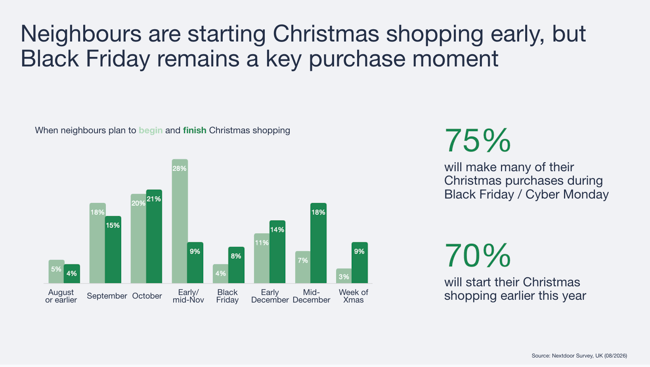
Christmas consideration is already underway well ahead of the traditional peak shopping period. 70% of neighbours will start their Christmas shopping earlier this year, and retailer choice stays unsettled long past the big sales moment — even food and groceries, the most-decided category measured, still has 49% undecided.
- 28% plan to begin their Christmas shopping as early as November, the single most common start point
- 75% will make many of their Christmas purchases during Black Friday and Cyber Monday — the largest concentration of purchase intent in the season
- 18% plan to finish their shopping in mid-December, the most common finish window
Implication for advertisers: Build awareness and consideration early, ahead of the 28% surge into early/mid-November, then shift budget toward purchase-oriented creative and promotional messaging as Black Friday and Cyber Monday approach. With 60% of electronics shoppers and more than half of shoppers in beauty, clothing, and home decor still deciding where to buy, maintaining visibility through mid-December — not just through Black Friday — is what actually wins the sale.
Value-seeking behavior is shaping every purchase, not just the deals themselves
Neighbours are planning to spend, but that doesn't mean value is secondary — most expect to actively stretch their Christmas budgets this year, and 81% say finding the right gift matters more than getting the lowest price, so value-seeking and gift quality aren't in tension for most neighbours.
- 79% will cut back on everyday expenses to afford Christmas gifts
- 75% will wait for sales before making most Christmas purchases
- 73% will shop at charity shops, car boot sales, or online marketplaces as part of their Christmas shopping
- 66% are likely to open a new credit card to cover Christmas spending, 53% more than the general population — most often to access store specific discounts (24%, +60% vs. general population) or increase available credit (21%)
Implication for advertisers: Make savings and promotions easy to spot — sales windows, store-specific discounts, and 0% APR or credit offers all map directly to how neighbours say they'll stretch their budgets this year. But price shouldn't replace the product story: with 81% prioritising the right gift over the lowest one, promotional messaging works best paired with a clear reason a product makes a good gift, not in place of one.
Online convenience and nearby stores will split the season, and delivery anxiety is real
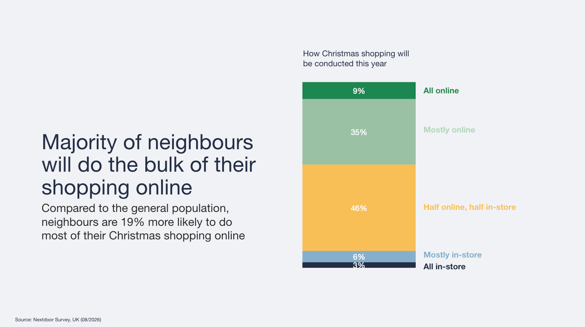
Online will capture a substantial share of Christmas shopping this year, but nearby stores keep a distinct role. Only 9% will shop entirely online, while 46% will split their shopping evenly between online and in-store — neighbours are 19% more likely than the general population to do most of their Christmas shopping online.
- Top reasons to shop nearby instead of online: ability to see products before purchasing (35%) and getting the item immediately (32%)
- 41% expect a last-minute trip to a nearby store for food or ingredients, and 34% for Christmas decorations, 48% more than the general population
- 72% are concerned about having Christmas packages stolen; in response, 45% will track delivery notifications and 42% will schedule deliveries for when someone's home
Implication for advertisers: Digital-first brands should prioritise this audience while making the path from consideration to online purchases as short as possible. Omnichannel retailers should give nearby stores a distinct role in creative — built around immediacy and forgotten-item moments, since 41% expect a last-minute food and ingredients trip and 34% expect one for decorations. Any brand offering a delivery should feature options that directly address theft concerns, like scheduled delivery windows or pickup locations.
Local and independent retailers have a real opening, if national chains can't out-quality them
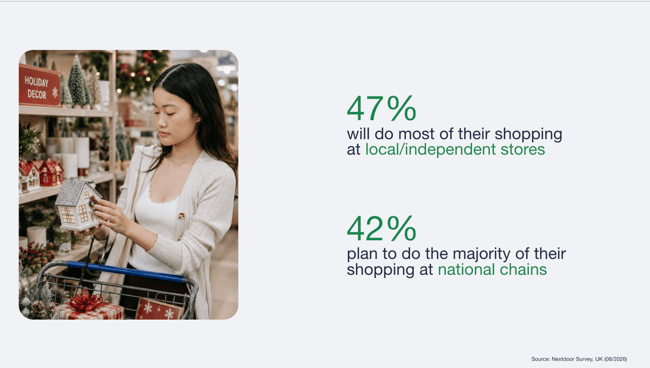
National chains and local, independent stores are set to split Christmas spending fairly evenly this year. 47% will do most of their shopping at local or independent stores, while 42% favour national chains, and the two retailer types win for different reasons.
- 73% are willing to pay a little more to support local businesses during the Christmas period
- National chains lead on lower prices (32% vs. 18%) and better promotions (36% vs. 32%)
- Local stores win on unique gift options (29% vs. 21%) and support for local businesses (34%), with comparable marks on customer service and sustainable options.
The standout finding here is guidance: AI tools are now the single most-used source for investment guidance (36%), ahead of financial news sites (35%), friends and family (32%), and even a professional financial adviser (30%). That's an early-adopter, digitally confident audience that automated and human advisers alike need to compete for.
Implication for advertisers: National advertisers competing for Christmas budget should borrow from what makes local retailers resonate — quality, distinctive gift options, and community relevance — rather than relying on price and convenience alone. Local and independent advertisers should make the 73% willing to pay more explicit in their creative, leaning into quality, service, and unique inventory instead of trying to win a price fight they're not built for.
AI, reviews, and trusted recommendations are doing more of the gift-finding work
Coming up with gift ideas is the single biggest source of Christmas shopping stress: 73% consider Christmas shopping a stressful experience, and gift ideas top the list of reasons (45%), ahead of finding the best deals (40%) and dealing with crowds (35%). Neighbours are turning to a widening set of tools and sources to solve it.
- 60% will use AI-powered tools to help with Christmas shopping, 43% more than the general population — most often for generating gift ideas (45%) and comparing prices (44%)
- Online reviews are the single most influential source on Christmas shopping lists (77%), ahead of ads on apps or platforms (74%) and AI-powered tools (72%)
- 61% trust recommendations on Nextdoor more than those on other platforms
The standout finding here is guidance: AI tools are now the single most-used source for investment guidance (36%), ahead of financial news sites (35%), friends and family (32%), and even a professional financial adviser (30%). That's an early-adopter, digitally confident audience that automated and human advisers alike need to compete for.
Implication for advertisers: With gift discovery as the top stress point, brands that make inspiration part of their Christmas creative — clearly showing who a product is for and why it fits — can become part of the solution while shoppers are still deciding what to buy. Pair that creative with credible reviews and recommendations: as AI plays a bigger role in comparing options, brands that show up clearly in reviews and trusted local recommendations are the ones AI tools and neighbours alike are most likely to surface.
Holiday shopping advertising playbook: how to activate on Nextdoor
Bringing it all together, here’s how to turn these insights into action:
1. Build consideration before the November surge
70% of neighbours are starting their Christmas shopping earlier this year, and 28% begin in early or mid-November alone. Launch awareness and consideration creative ahead of that window, then shift toward promotional messaging as Black Friday and Cyber Monday approach, when 75% will make many of their purchases.
2. Lead with tangible value, not just discounts
With 79% cutting back on everyday spending and 75% waiting for sales, make specific offers — store discounts, 0% APR, sign-up bonuses — easy to find, while keeping a clear gift story front and centre, since 81% value the right gift over the lowest price.
3. Give nearby stores a distinct role in creative
Feature immediacy and product visibility, the top two reasons neighbours choose stores over online (35% and 32%), and target last-minute occasions like a forgotten gift (35%) or hosting supplies (36%).
4. Stay in consideration through mid-December
Retailer decisions remain unusually open, from 60% still deciding on electronics to roughly half still deciding on food and groceries. Keep investing in consideration-building activity after Black Friday rather than assuming the sale is already won.
5. Make your brand easy for AI and reviews to recommend
60% of neighbours will lean on AI tools and 77% cite online reviews as influential. Keep product benefits, pricing, and reviews clear and easy to parse for both shoppers and AI-assisted research, particularly since 61% trust Nextdoor recommendations more than those on other platforms.
Source: Nextdoor Survey, UK (08/2026)