

Home decor on Nextdoor: 2026 insights for advertisers
Home decor is more than just a seasonal update for neighbors — it's a continuous cycle of engagement and improvement. On Nextdoor, this focus is visible through an audience that isn't just updating their spaces, but is doing so with a high frequency and a focus on quality.
New research from Nextdoor's April 2026 Home Decor Insights Report reveals a neighbor population that is style-driven, open to brand switching, and deeply influenced by the renovation they see in their own backyards. For home decor brands, this represents a prime opportunity to reach the primary decision-makers who are actively researching their next purchase.
The continuous home decor shopper
Neighbors are not just "situational" shoppers, they represent a remarably active segment of the market. While the general population might wait for a specific need, 93% of neighbors plan to update their home decor in the next 12 months, making them 10% more likely to do so than the general population.
Nextdoor users are also in a cycle of continuous engagement:
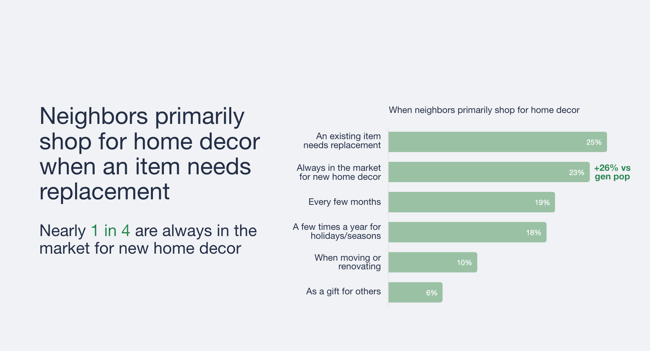
- Nearly 1 in 4 neighbors are always in the market for new pieces, which is 26% more likely than the general population.
- 25% of neighbors shop when an existing item needs replacement, while others shop every few months (19%) or seasonally (18%)
- Comfort (20%) and style refreshes (17%) are the main motivators for these updates, rather than just funcitonal necessity
Implication for advertisers: Maintain a sustained presence rather relying solely on seasonal bursts. Since a significant portion of the audience is always in "browse and buy" mode, consistent visibility ensures you capture demand the moment it surfaces.
Reaching the household decision-maker
On Nextdoor, brands reach the person who actually controls the budget. 65% of neighbors are the primary household decision-makers for home decor in their households. This is a direct line to the buyer, allowing messaging to act as a catalyst for immediate action without the need for a "second conversation."
Implication for advertisers: Write copy that speaks directly to the decision-maker with confidence. Use direct calls to action like "Your space, your call" or "Shop the look" to resonate with the person in charge of the purchase.
Local influence and community discovery
In a category driven by aesthetics, neighbors turn to their local community for real-world inspiration. While social media is the main source for general inspiration (56%), Nextdoor holds a unique position in the research phase.
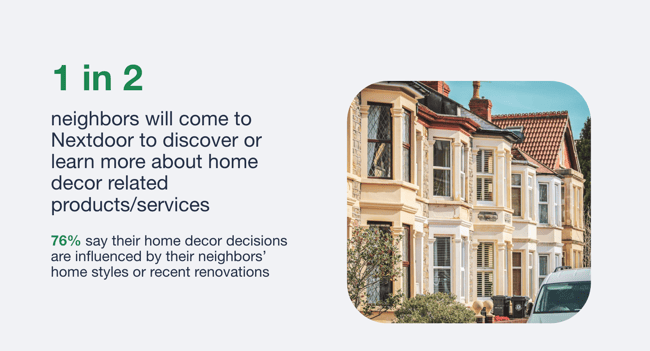
- 1 in 2 neighbors turn to Nextdoor specifically to discover or research home decor products and services
- 76% of neighbors state their decor decisions are influenced by their neighbors' home styles or recent renovations
Implication for advertisers: Position your creative as inspiration rather than an interruption. Use neighborhood-relevant copy like "Trending in your area" or "See what your neighbors are choosing" to tap into the local trust dynamic.
Design and durability over price
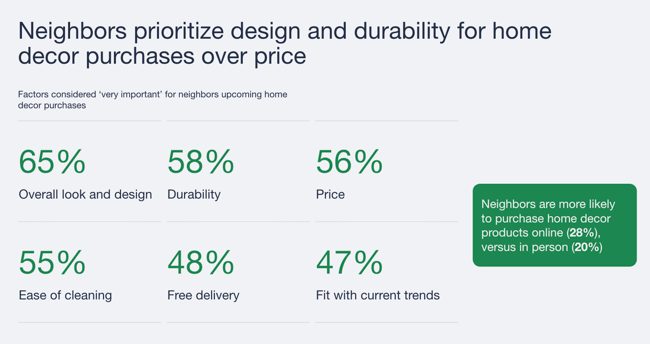
Neighbors are high-value shoppers who prioritize the long-term look and feel of their homes over the lowest price tag. When evaluating a purchase, they rank overall look and design (65%) and durability (58%) as more important than price (56%).
Furthermore, this audience is highly "conquestable":
- 82% of neighbors are willing to switch brands or have no specific store loyalty
- 46% of neighbors will switch for a better promotion or unique style, while 36% shop purely for the best product
Implication for advertisers: Lead with high-quality lifestyle photography and styled room imagery to appeal to the design-first mindset. If your product has a quality story, tell it — neighbors are specifically looking for items that are "built to last."
The DIY mindset: high intent for home projects
Neighbors aren't just buying furniture, they are active "project-doers." Nearly half (48%) of neighbors planning a furniture purchase intent to assemble or install the items themselves.
The DIY inclination makes them a prime audience for adjacent categories.
- Window treatments are a massive growth area, with neighbors being 53% more likely than the general population to be planning an update
- Outdoor spaces and dining room also see significant over-indexing, with neighbors 50% and 36% more likely to upgrade these areas than the general population
Implication for advertisers: For home improvement retailers like Home Depot or Lowe’s, this audience represents a full project journey. Neighbors who self-assemble often require supplementary tools, hardware, or finishing materials. Position your campaigns as the “natural next stop” with messaging like “Everything you need to finish the job” or “Your project starts here” to capture spending beyond the initial furniture purchase.
Home decor advertising playbook: how to activate on Nextdoor
Bringing it all together, here’s how to turn these insights into action:
1. Stay always-on, but peak in the summer
While 1 in 4 neighbors are always shopping, platform activity and home decor conversations peak in the summer (up 17-18% over the average month). Begin ramping spend in May to capture research-phase intent before the peak summer momentum.
2. Win undecided shoppers with a "look and lead" approach
Since a large portion of neighbors are open to switching brands, lead your creative with the “look” and close with the “offer.” Neighbors are sale-sensitive – 82% wait for a seasonal sale – but they won’t sacrifice style for a discount.
3. Target by specific high-growth categories
Prioritize category-specific campaigns for window treatments, accent furniture, and large furniture. Neighbors in these segments are disproportionately concentrated on the platform.
4. Build for a fast conversion cycle
Nearly half of neighbors expect to follow through with a purchase in just a few days or less from starting their research. Use limited-time offers or “sale ends soon” messaging to compress this consideration phase even further.
5. Optimize for the online purchase path
Neighbors are more likely to purchase home decor products online (28%) than in person (20%). Ensure your Nextdoor campaigns link to a frictionless e-commerce experience to capture the high-intent generated by your creative.
Source: Nextdoor Survey, US (04/2026)