


Back-to-school on Nextdoor: 2026 insights for advertisers
The back-to-school (BTS) season is historically marked by a rush for binders, backpacks, and tech upgrades. However, today’s parents are entering the school year with a more deliberate, community-minded, and tech-receptive mindset. Parents are carefully evaluating their purchasing options, looking for ways to stretch their seasonal dollars, and leaning heavily on local networks to establish new household routines.
New data from Nextdoor's June 2026 Back-to-School Insights Report reveals a highly active, intent-driven audience of family buyers. For major retailers, grocers, apparel brands, and CPG providers, these findings sketch a distinct roadmap for capturing market share well before the opening school bell rings.
An early, high-budget consumer market
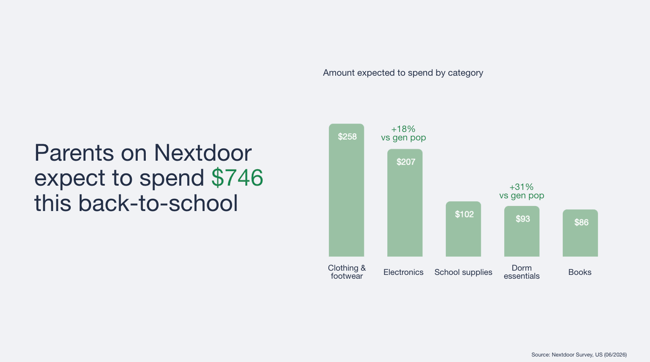
Parents approach the return to school with an undeniable willingness to invest, but rising prices are shifting their purchase timelines. Neighbors on Nextdoor project an average back-to-school spend of $746 per household. This spend spans across five definitive spending verticals:
- Neighbors are expected to spend $258 on clothing & footwear
- Neighbors are expected to spend $207 on electronics, 18% more likely than the general population
- Neighbors are expected to spend $102 on school supplies and $86 on books
- Finally, neighbors are expected to spend $93 on dorm essentials, 31% more likely than the general population
Driven by these expanding needs, 70% of parents state they plan on spending more this year, primarily citing higher baseline prices (66%) , extra required supplies on school lists (50%) , and increased activity or sports participation (53%).
To stay ahead of these growing financial demands, parents are pulling their shopping timelines forward. More than half of all parents will start their seasonal shopping by early July.
Implication for advertisers: Because neighbor budgets are highly elevated and concentrated in early summer, waiting until August to launch media campaigns is a losing strategy. Brands should secure a prominent baseline presence in late June and early July to capture parents as they first map out their larger footwear, clothing, and electronics allocations. Brands in higher-spend categories should position their products as investments that will serve families throughout the school year.
The value driven routine: stretching budgets through strategic shopping
Although 81% of parents look forward to their children returning to school and 89% view the shopping process as an opportunity to bond , the experience remains highly stressful for 68% due to crowded stores and deal-hunting pressures. Consequently, parents are moving completely away from impulse buys and acting as highly analytical, pragmatic shoppers:
- 62% of neighbors are deliberately comparing prices across multiple retailers
- 49% of neighbors are waiting specifically for major sales and promotional windows
- 45% of neighbors plan to purchase more store-brand (private label) items
- 42% of neighbors plan to reuse supplies from previous years
- 39% of neighbors expect to shop secondhand, 10% more likely than the general population
This value-driven mindset is creating fluid brand loyalty. Over half of parents (55%) state that major digital shopping events (such as Amazon Prime Day) significantly dictate their final choices, which is 20% more likely than the general population. Furthermore, neighbors are 71% more likely than the general population to execute their back-to-school shopping online.
Implication for advertisers: To mitigate the stress of back-to-school shopping, lead with direct price-matching transparency, feature bundled rewards, and lean into digital events. In terms of distribution, optimize fulfillment channels to meet neighbors with convenience and consistency so that messaging is aligned regardless of where purchases occur.
Settling into new routines: shifting grocery and weeknight behaviors
As school resumes, grocery and meal routines experience a substantial shift. Parents are opening their wallets wider at the supermarket, with 44% spending more on groceries overall. Household grocery shopping changes in a variety of ways during the school year:
- 50% of neighbors purchase more snacks, 14% more likely than the general population
- 44% of neighbors look for more deals and promotions
- 43% of neighbors purchase more breakfast items and buy in bulk more often
- 42% of neighbors purchase more lunch items, 39% more likely than the general population
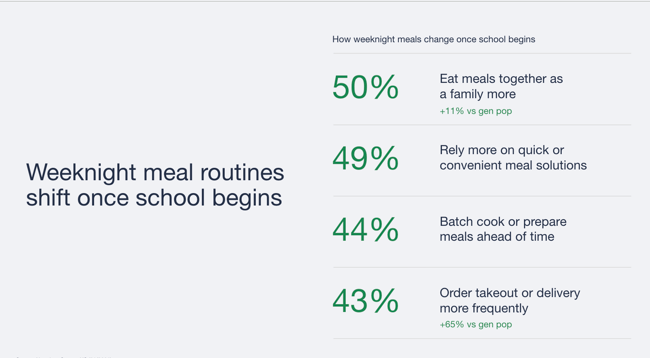
Weeknight meal routines face similar shifts. While 50% prioritize eating meals together as a family more often (11% more likely than the general population), they balance this intention with convenient solutions: 49% rely more heavily on quick or convenient meal choices, 44% batch cook or prepare meals ahead of time, and 43% order takeout or delivery more frequently, 65% more likely than the general population.
Implication for advertisers: Grocery retailers and CPG food brands should tailor their messaging to the clock. Feature bulk snack options, quick-assembly school lunch packages, and high-velocity breakfast items. For quick-service restaurants (QSR) and food delivery apps, highlight stress-free weeknight family bundles to directly capture the parents leaning into takeout convenience once the homework cycle begins.
A community first mindset
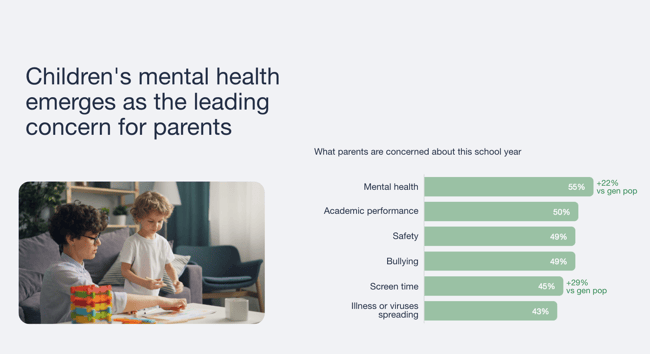
The modern back-to-school conversation extends far beyond materialistic needs. Today's parents display an intense focus on their children's holistic development and safety. Notably, children's mental health stands out as the leading parent concern entering the school year (55%), outranking academic performance (50%), safety (49%), bullying (49%), excessive screen time (45%), and illness (43%).
Neighbors are translating these personal values into community-wide support networks. Parents on the platform are uniquely focused on ensuring collective classroom success:
- 51% plan to contribute directly to a teacher or classroom wish list, 21% more likely than the general population
- 49% will donate or pass along gently used supplies or clothing to neighborhood families, 26% more likely than the general population
- 40% expect to purchase extra supplies for their children's classroom, 25% more likely than the general population
Implication for advertisers: Purpose-driven marketing carries unmatched resonance during this window. Brands can build deep trust by deploying campaigns centered around student well-being, mental health resources, and neighborhood give-back programs. Align your enterprise directly with these organic communal actions by hosting supply donation drives or matching teacher wish-list contributions.
Back-to-school advertising playbook: how to activate on Nextdoor
Bringing it all together, here’s how to turn these insights into action:
1. Meet the community planning where it happens
Nextdoor functions as an active utility platform during this high-intent period, with 85% of parents expecting to rely on Nextdoor for at least one aspect of back-to-school planning. Run native, localized ad copy that fits naturally within these high-trust neighborhood conversations.
2. Focus creative directly on transparent pricing and service records
This family demographic values time-saving tech innovations. 53% of parents are very likely to use AI tools to help with planning or shopping, 77% more likely than the general population. Brands should explicitly feature digital tools, AI-powered list matching, or streamlined app conveniences in their top-funnel copy to attract these tech-receptive planners.
3. Speak to the children driving co-authored decisions
While supply lists (57%) and online reviews (34%) are core criteria , children drive 62% of heavy shopping decisions. Because only 23% of parents handle the process entirely solo without kids participating, design your visual assets and apparel/tech offerings to appeal to a co-authored shopping dynamic where kids dictate style and comfort
Source: Nextdoor Survey, US (06/2026)