

Home insurance on Nextdoor: 2026 insights for advertisers
The home insurance landscape is experiencing a period of significant consumer movement. Driven by shifting market realities, traditional brand loyalty is giving way to active exploration. Insurance providers can no longer rely on structural inertia to maintain their books of business. Instead, growth will belong to carriers that understand how to communicate directly with high-intent decision-makers during critical comparison windows.
New data from Nextdoor's June 2026 Home Insurance Insights Report profiles a highly active, switch-ready audience of property owners. For insurance brands, this research highlights a major opportunity to secure premium market share by aligning acquisition and retention efforts with localized, community-driven behavior.
Reaching the definitive household decision-maker
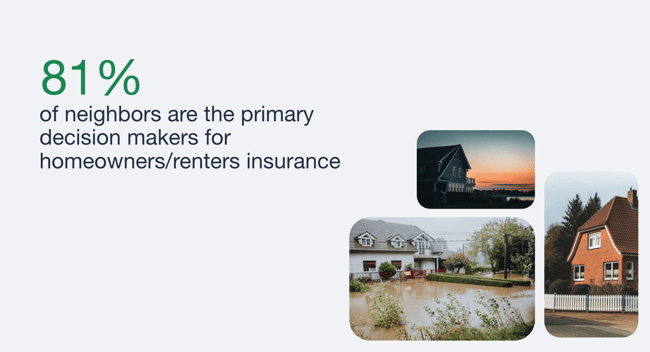
Unlike other platforms where advertising spend frequently reaches casual researchers or secondary household influencers, Nextdoor cuts straight to the core buyer. An incredible 81% of neighbors are the primary household decision-makers for home insurance, meaning every dollar spent directly connects with the individual holding ultimate purchase authority.
Furthermore, this target audience has clear, established property profiles that dictate their buying patterns:
- 78% of neighbors live in single-family homes, making them high-value property owners with extensive coverage requirements
- 48% of neighbors hold plans that cover their home and belongings from the most risks, far outranking bare-bones or heavily restricted policy lists
- 38% of neighbors have their separate auto policy with their home insurance company and 41% consolidate high-value item protection under the same provider, displaying a deeply ingrained habit of policy consolidation
Implication for advertisers: Because this audience is comprised of primary decision-makers who naturally prefer broad, comprehensive single-family protection, your creative strategy should match their scale. Skip the promotion of highly specialized add-on packages during customer acquisition. Instead, highlight top-tier property protection using copy like "Everything under your roof, covered."
The massive market opportunity to switch
The defining characteristic of today's home insurance consumer is an unprecedented openness to exploring alternatives. Despite the fact that general satisfaction with current providers sits at 93%, structural frustrations have made customer loyalty extremely fragile.
A staggering 74% of neighbors are likely to consider switching home insurance providers in the next 12 months — making Nextdoor's audience 14% more likely to switch than the general population.
- Annual premium increases represent the single largest neighbor frustration, impacting 37% of property owners
- 32% of neighbors report a major frustration with transactional silence, stating they only hear from there insurance company when it is time to pay
Additionally, when these switchers are actively shopping, the factors they prioritize remain consistent. Monthly premiums (73%) and customer service quality (69%) outrank brand reputation (52%), digital claims features (45%), or generic bundling discounts (35%).
Implication for advertisers: The widespread frustration over modern communication loops and rate increases is your competitive entry point. Position your carrier as a proactive, transparent, year-round partner. Run conquesting ads that directly highlight customer service credentials and transparent pricing structures to pull market share away from silent, legacy competitors.
The data-literate consumer
Nextdoor neighbors do not simply wait around for an external trigger or a moving event to compare alternative insurance products. They are deeply engaged, financially literate shoppers who actively audit their coverage:
- 30% of neighbors compare quotes every single year at renewal and 24% occasionally shop around even if their premiums haven't gone up
- 46% of neighbors read their entire renewal in detail each year, 15% more likely than the general population
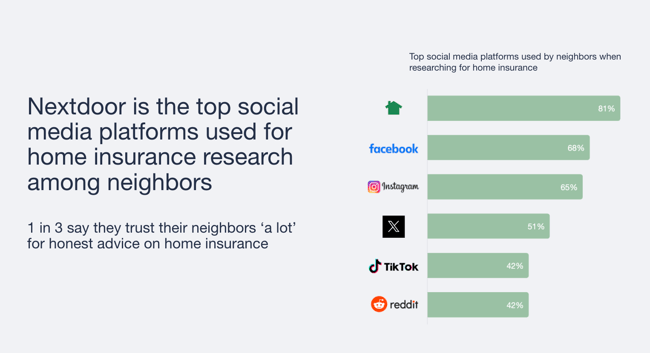
When looking for information to guide these decisions, neighbors utilize a cross-channel mix of human enterprise and digital discovery. Insurance company agents (43%), search engines (42%), and independent brokers (41%) represent the top research channels. However, when utilizing a social loop for research, Nextdoor stands out as the leading social media platform for home insurance research (81%), far outperforming Facebook (68%) or Instagram (65%). 1 in 3 neighbors trust their neighbors "a lot" for honest advice on home insurance.
Implication for advertisers: Because nearly half of your target audience reads their renewal contracts, utilize detailed side-by-side coverage comparisons, explicit savings calculations, and direct-response quote paths that make their regular checkups completely frictionless. Leverage ad formats that feel native to organic neighbor conversations — like sponsored posts that surface local testimonials — to reach those relying on their neighbor's recommendations.
Climate volatility and technical convenience shaping future coverage
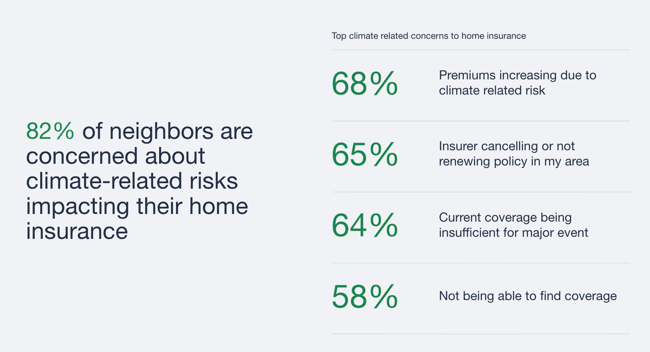
As property owners look toward the horizon, emerging environmental concerns and technological preferences are significantly shifting how they evaluate carrier value. 82% of neighbors are concerned about climate-related risks impacting their home insurance coverage. Their primary anxieties center around premium spikes due to localized weather risk (68%), sudden policy cancellations or non-renewals within their specific geographic area (65%), and discovering their current plan features are completely insufficient for a major event (64%).
Simultaneously, neighbors are welcoming the strategic integration of AI into their experiences, highlighting a distinct comfort with automated tools across several operational touchpoints:
- 82% of neighbors are comfortable with AI recommending customized coverage options
- 82% of neighbors trust AI systems to process and evaluate insurance claims
- 81% of neighbors are open to premium setting based on automated property data
Implication for advertisers: Break through generic insurance ad copy by explicitly showcasing climate resilience and rapid digital convenience. Geographically tailor your creative assets to directly answer hyper-local concerns, addressing hurricane risks on the Gulf Coast or wildfire updates out West. Furthermore, don't hide your digital innovations in the fine print — lead with messaging that shows how automated quoting saves them time and increases accuracy.
Home insurance advertising playbook: how to activate on Nextdoor
Bringing it all together, here’s how to turn these insights into action:
1. Pulse your media investments around verified conversation spikes
While home insurance research is a continuous, always-on baseline necessity, community conversations on Nextdoor predictably peak during specific cyclical windows. Mentions of provider changes surge significantly in January and July as rate hikes roll out. Plan your high-impact direct-response budget adjustments and premium quote pushes for 4 to 6 weeks in advance to capture this peak switcher volume before legacy competitors enter the market.
2. Focus creative directly on transparent pricing and service records
When addressing a switch-ready market, creative hierarchy must follow the data. Lead your ads with upfront pricing transparency, clear rate breakdown tools, and concrete savings calculations to immediately hook the 73% prioritizing premiums. Support that financial offer with your claims efficiency window or independent service rating to target the 69% focused on customer care.
3. Address geographic weather risks with educational hooks
With 82% of property owners anxious about volatile climate shifts, advertisers can stand out by introducing helpful, localized coverage verification content. Deploy geo-targeted sponsored posts that answer common regional coverage questions to position your brand as a trusted advisor, directly resolving the baseline coverage anxieties holding consumers back.
4. Deploy friction-free direct-response CTAs
Because 65% of neighbors have actively shopped for coverage in the last 3 years and are highly comfortable using automated AI tools, Nextdoor operates as a direct-response conversion engine, not just a brand building channel. Skip ambiguous brand-heritage creative and favor urgent, action-oriented CTAs like "Explore customized payment options" and "Get a personalized recommendation" to move high-intent shoppers seamlessly into the conversion funnel.
Source: Nextdoor Survey, US (05/2026)