


Pet ownership on Nextdoor: 2026 insights for advertisers
As any pet parent will tell you, dogs, cats, and other animals aren’t just companions — they’re family. On Nextdoor, that bond is especially visible in the feed, from daily dog‑walk photos to “lost and found” pet posts that mobilize entire neighborhoods.
New research from Nextdoor’s 2026 U.S. survey shows just how central pets are to neighbor life — and how advertisers can tap into this pet‑first mindset to build trust, drive sales, and become part of everyday care routines.
Pet ownership is the norm on Nextdoor

Pet ownership is truly mainstream on Nextdoor: 71% of neighbors own a pet, with dogs (52%) and cats (46%) leading the way, followed by fish and birds. With nearly three‑quarters of the platform caring for animals at home, this isn’t a niche audience — it’s the default.
Neighbors also see Nextdoor itself as a pet‑forward community space, from product recommendations and pet care referrals to lost‑pet alerts that rally the neighborhood.
Implication for advertisers: Treat Nextdoor as a pet‑first channel. Assume a large share of your audience is a pet parent, even if you’re not an endemic pet brand. Simple shifts — adding authentic neighborhood pet imagery or acknowledging “the four‑legged member of the family” — can immediately increase relevance in the feed.
Pets support companionship, mental health, and active living
Neighbors bring pets into their lives for reasons that go well beyond “liking animals.” Companionship is the #1 motivation (70%), but a sizable share point to mental health benefits (27%) and a desire to be more active (22%), alongside making their children or partners happy.
For many, pets are emotional anchors, accountability partners for exercise, and key to a calmer home.
Implication for advertisers: Lead with emotional and lifestyle outcomes, not just functional benefits. Whether you’re selling food, treats, home products, or services, show how your brand helps neighbors spend more quality time together, reduce stress, and support healthier routines for both pets and people.
Welcoming a new pet triggers a whole‑home reset

For the 30% of neighbors who are new pet owners in the last year, bringing home a pet sparks wide‑ranging changes in how they manage their homes and health:
- 88% prioritize buying non‑toxic products for their home
- 84% clean their home more often
- 80% feel safer at home
- 67% get more exercise and feel healthier since getting a pet
A new pet isn’t just an incremental purchase; it’s a catalyst for upgraded cleaners, home protection, routines, and gear.
Implication for advertisers: Treat the “new pet” window as a major household reset moment. Bundle solutions across categories — non‑toxic cleaners, air care, smart home tech, fitness gear, and training tools — into “welcome home” offers. Focus on the idea of making the home safer, healthier, and more comfortable for everyone, with the pet at the center.
Pet parents are high‑spend, always‑on shoppers
Pet ownership comes with serious, ongoing investment. On average, neighbors spent $1.4K on their pets in the last year, with the majority going to food (~$548) and vet care (~$530), followed by grooming, toys, and pet sitting.
Spending is steady across the year rather than spiky, reflecting the daily and weekly nature of pet care decisions.
Implication for advertisers: Adopt an always‑on media approach that mirrors ongoing spend rather than one‑off campaigns. Emphasize long‑term value and health outcomes — healthier pets, fewer emergencies, better quality of life — to justify premium price points and nurture loyalty over time.

Neighbors prefer digital convenience, backed by trusted retailers
Pet parents on Nextdoor are comfortable shopping across channels. About 60% do at least half of their pet shopping online, and neighbors are 10% more likely than the general population to shop mostly or entirely online for pet supplies.
At the same time, Walmart is the most popular retailer for pet supplies (65%), and neighbors significantly over‑index for Chewy and Target, blending local convenience with digital ease.
Implication for advertisers: Design campaigns that bridge the digital and local shelf. Use creative that pairs “In stock at your local [retailer]” with “Shop now” or “Subscribe & save” CTAs. This meets neighbors where they’re already shopping — in store, online, or both — and makes it easy to move from feed to checkout in a single tap.
Recommendations and advice power pet decisions
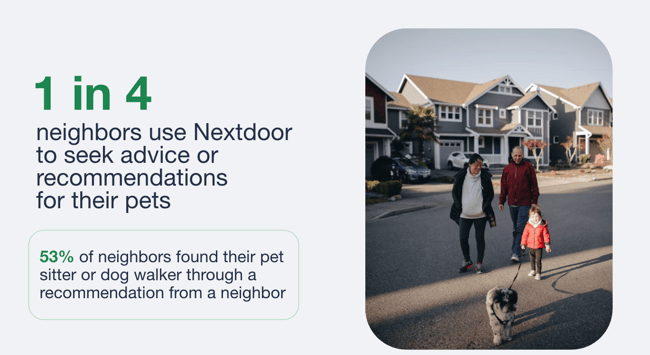
Nextdoor functions as a pet advice hub. 1 in 4 neighbors uses Nextdoor to seek advice or recommendations for their pets, and 53% found their pet sitter or dog walker via a neighbor recommendation.
Neighbors don’t just transact; they share experiences, compare solutions, and publicly endorse businesses they trust.
Implication for advertisers: Build campaigns that plug into the recommendation loop. Encourage satisfied customers to fave your business, leave reviews, and respond in local threads. Pair that social proof with content‑forward creative — quick tips, checklists, “what I wish I knew” guides — so your brand shows up as the helpful answer when neighbors ask, “Who do you use for…?”
Pet advertising playbook: how to activate on Nextdoor
Bringing it all together, here’s how to turn these insights into action:
1. Treat pet owners as a primary, always‑on audience
Pet ownership is a defining characteristic of the platform, and spend is consistent across the year. Use Nextdoor’s Pet Owners interest segment (~25.2M neighbors) and maintain a presence that reflects the ongoing cadence of food, vet, grooming, and boarding purchases — not just seasonal spikes.
2. Lead with emotional, lifestyle‑driven storytelling
Companionship, mental wellbeing, and active living are central to why neighbors have pets. Anchor creative in emotional outcomes — feeling calmer at home, getting outside more, feeling proud of how well their pet is cared for — and then reinforce with functional proof points like efficacy, convenience, and value.
3. Capture “new pet” and “new year” reset moments
New pet ownership and the start of a new year are key inflection points when neighbors rethink routines, health, and home environments for their pets.
- Build welcome‑home bundles across CPG, home, and security categories.
- Position products and services as “resolution partners” for pet health, exercise, and hygiene.
- For insurance and safety brands, prioritize the day‑one coverage window to capture the 74% who commit right away.
4. Win on both the digital and local shelf
Neighbors are heavy online shoppers but remain loyal to local retailers like Walmart and Target while also over‑indexing for Chewy and other e‑commerce players.
- Use geo‑targeted creative that highlights nearby store availability.
- Pair in‑store messaging (“pick up today at your local…”) with click‑to‑buy CTAs and subscription offers.
- For retailers, position your storefront as the one‑stop neighborhood hub for everyday pet needs.
5. Turn grooming, boarding, and pet care into recurring relationships
High frequencies in grooming, boarding, and pet sitting make these ideal categories for recurring revenue and loyalty programs.
- Offer membership tiers or subscription grooming packages.
- For boarding/daycare, lead with cleanliness, transparency (webcams), and 24/7 care.
- Use social proof and neighbor recommendations to de‑risk trial for first‑time customers.
7. Plug directly into the recommendation engine
With 1 in 4 neighbors using Nextdoor for pet advice and over half finding pet sitters via recommendations, word‑of‑mouth is a primary growth channel.
- Encourage happy customers to fave your business and leave reviews.
- Respond to local threads with helpful, non‑salesy advice, then use paid formats to scale your presence where conversations are already happening.
- Pair recommendation‑heavy creative with in‑feed offers for easy trial.
As pet care continues to evolve, understanding how neighbors on Nextdoor think about their animals — from adoption and food choices to grooming, boarding, and safety — can help brands show up in ways that feel truly helpful, not intrusive. With the right mix of emotional storytelling, local activation, and recommendation‑driven strategy, advertisers can become part of the everyday rituals that help neighbors care for the pets who feel like family.
Source: Nextdoor Survey, US (01/2026)