

Dining out on Nextdoor: 2026 insights for advertisers
Neighbors spend about $60 a week dining out, 21% more than the average consumer. They also act on what they see locally: 67% have considered a QSR or casual dining restaurant after a recommendation on Nextdoor (up 17% year over year), and 61% after an advertisement. These findings come from Nextdoor's October 2026 Dining Out Insights Report. This breaks down what drives restaurant choice and how QSR local advertising can meet neighbors at each decision point.
Neighbors spend more dining out, and higher prices drive much of the increase
Neighbors spend about $60 per week at restaurants, 21% more than the average consumer, and 53% are spending more than last year. 51% are typically responsible for deciding where their household buys meals, 16% more than the general population.
- 58% purchase lunch at a restaurant weekly or more often, 53% for breakfast, and 52% for dinner
- 54% cite higher prices as a reason they spend more
- 43% cite rising grocery costs
- 38% cite busier schedules
- 37% want to treat household members
Implication for advertisers: Neighbors are a high-value restaurant audience, but part of the extra spend reflects price pressure, not extra consumption. Show the value behind the purchase, whether that's food quality, portion size or a relevant meal offer. Because restaurant buying happens at all three meals, you don't need to limit your messaging to one dining occasion. Tailor creative to the meals you serve and give these household decision-makers a clear reason to choose you.
Busy schedules and the holidays drive more restaurant visits
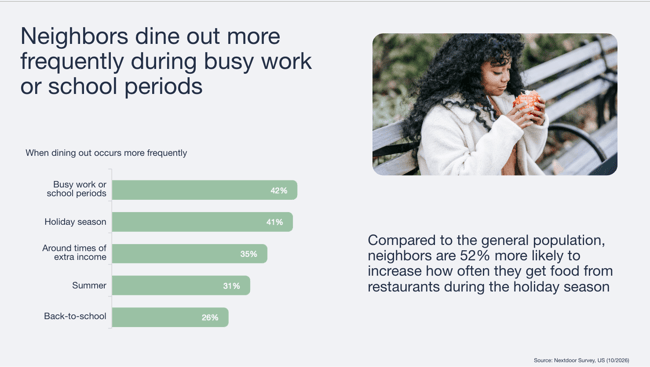
Neighbors are 52% more likely than the general population to increase restaurant purchases during the holiday season, so the current quarter is a peak window for QSR and casual dining advertisers. The occasions that lift dining out most:
- 42% during busy work or school periods
- 41% during the holiday season
- 35% around times of extra income
- 31% in summer
- 26% at back-to-school
Implication for advertisers: Purchasing follows the calendar, so spend should too. Concentrate campaigns around these moments and match the message to the situation. Lead with convenience when schedules are packed, and feature meal offerings built for the occasion over the holidays, where neighbors over-index.
Cravings, treats and proximity decide where neighbors eat
Neighbors choose restaurants over cooking for the food and the treat, not only for convenience. 45% wanted a specific restaurant's food (+13% vs. the general population) and 44% wanted to treat themselves or their family (+29%). Food quality or taste (39%) and a convenient location (35%, +17%) lead restaurant selection. 61% get most or all of their restaurant meals within 10 minutes of home. Neighbors travel farther to dine in: 34% set a 10-minute limit versus 65% for takeout.
- 54% of those who order online usually go through the restaurant's own site or app
- 41% buy all restaurant meals in person and 28% mostly in person
QSR, fast-casual and local restaurants win on different strengths
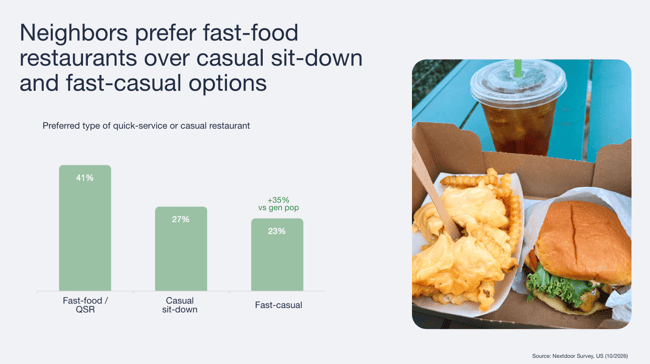
When it comes to dining out, fast-food/QSR is the preferred type at 41%, followed by casual sit-down at 27% and fast-casual at 23% (35% more than the general population). Local versus chain is a near three-way split: 33% of neighbors prefer local or independent, 32% prefer national chains, and 35% have no preference. Neighbors prefer these options for different reasons:
- Neighbors prefer QSR for the convenience (44%) and faster service (41%)
- Neighbors prefer casual sit-down for quality or taste (48%), atmosphere (33%) and consistency (32%)
- Neighbors prefer national chains for value (30%) and consistency (27%)
- Neighbors prefer local restaurants for personalized service (31%), atmosphere (30%) and supporting local (36%)
Promotions and word of mouth shape trial. 41% of neighbors say coupons motivate them to try new items, and 32% say they convince them to act spontaneously (+28%), though 31% say offers expire too quickly. The main ways neighbors discover new places to dine out are through family and friends (20%), walking or driving by (19%), and social media (16%, +23%).
Implication for advertisers: Position for the format you are, not the category. QSR brands should own convenience and speed, casual restaurants quality and experience, and fast-casual brands the specific advantages that set them apart. Local ownership or national recognition alone won't carry the message with a split audience; chains can emphasize dependability and value, independents personal service and atmosphere. Build offers around a specific menu item or a timely reason to buy, with clear terms and a fair redemption window. Use geo-relevant ads to build familiarity with nearby locations alongside word of mouth.
Neighbors see restaurants as part of the community and want them to give back
79% of neighbors consider restaurants in their area part of the community (+11% year over year) and 69% say restaurants make it easier to connect with other, but 70% want them to do more to give back. According to neighbors, this is what would would make restaurants feel more connected to local communities:
- Supporting local charities (36%), 24% more than the general population
- Being locally owned or operated (35%)
- Offering discounts or promos for locals (34%), 26% more than the general population
Implication for advertisers: Community connection creates an expectation to give back. Reinforce your role in local life with specifics, not broad claims: name the neighborhood organization you partner with, the event you host or the offer you extend to nearby residents. Show your restaurant as the gathering place neighbors already see.
Dining out advertising playbook: how to activate on Nextdoor
Bringing it all together, here’s how to turn these insights into action:
1. Lead with what's on the menu
Feature a specific menu item with appetizing imagery. Cravings and treating yourself are the top two reasons neighbors choose a restaurant.
2. Set your radius by occasion
Use tight hyperlocal targeting for takeout and a wider radius for dine-in. Include a nearby location in every ad.
3. Time flights to demand
Concentrate spend on busy work and school periods and the holiday season. Neighbors are 52% more likely than the general population to increase restaurant purchases over the holidays.
4. Build offers that drive trial
Promote a menu item or a timely reason to buy, with clear terms and a fair redemption window.
5. Show up in the neighborhood
Name a local partner, event or resident offer. 79% of neighbors consider restaurants in their area part of the community, and 70% want them to give back more.
Source: Nextdoor Survey, US (10/2026)